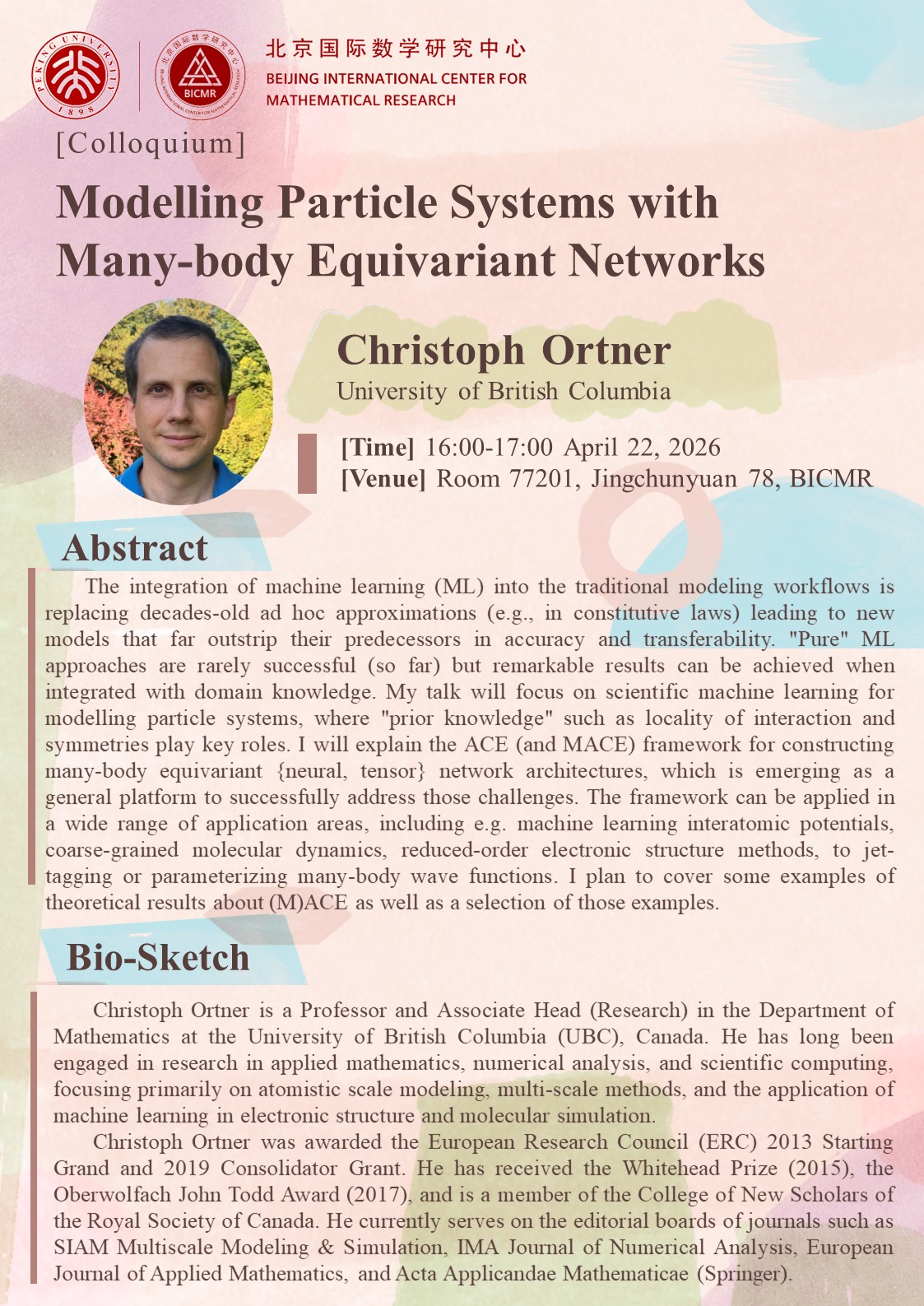
Modelling Particle Systems with Many-body Equivariant Networks
发布时间:2026年04月20日
浏览次数:754
发布者: Ruixin Li
主讲人: Christoph Ortner (The University of British Columbia)
活动时间: 从 2026-04-22 16:00 到 17:00
场地: 北京国际数学研究中心,镜春园78号院(怀新园)77201室
Abstract:
The integration of machine learning (ML) into the traditional modeling workflows is replacing decades-old ad hoc approximations (e.g., in constitutive laws) leading to new models that far outstrip their predecessors in accuracy and transferability. "Pure" ML approaches are rarely successful (so far) but remarkable results can be achieved when integrated with domain knowledge. My talk will focus on scientific machine learning for modelling particle systems, where "prior knowledge" such as locality of interaction and symmetries play key roles. I will explain the ACE (and MACE) framework for constructing many-body equivariant {neural, tensor} network architectures, which is emerging as a general platform to successfully address those challenges. The framework can be applied in a wide range of application areas, including e.g. machine learning interatomic potentials, coarse-grained molecular dynamics, reduced-order electronic structure methods, to jet-tagging or parameterizing many-body wave functions. I plan to cover some examples of theoretical results about (M)ACE as well as a selection of those examples.
Bio-Sketch:
The integration of machine learning (ML) into the traditional modeling workflows is replacing decades-old ad hoc approximations (e.g., in constitutive laws) leading to new models that far outstrip their predecessors in accuracy and transferability. "Pure" ML approaches are rarely successful (so far) but remarkable results can be achieved when integrated with domain knowledge. My talk will focus on scientific machine learning for modelling particle systems, where "prior knowledge" such as locality of interaction and symmetries play key roles. I will explain the ACE (and MACE) framework for constructing many-body equivariant {neural, tensor} network architectures, which is emerging as a general platform to successfully address those challenges. The framework can be applied in a wide range of application areas, including e.g. machine learning interatomic potentials, coarse-grained molecular dynamics, reduced-order electronic structure methods, to jet-tagging or parameterizing many-body wave functions. I plan to cover some examples of theoretical results about (M)ACE as well as a selection of those examples.
Bio-Sketch:
Christoph Ortner is a Professor and Associate Head (Research) in the Department of Mathematics at the University of British Columbia (UBC), Canada. He has long been engaged in research in applied mathematics, numerical analysis, and scientific computing, focusing primarily on atomistic scale modeling, multi-scale methods, and the application of machine learning in electronic structure and molecular simulation.
Christoph Ortner was awarded the European Research Council (ERC) 2013 Starting Grand and 2019 Consolidator Grant. He has received the Whitehead Prize (2015), the Oberwolfach John Todd Award (2017), and is a member of the College of New Scholars of the Royal Society of Canada. He currently serves on the editorial boards of journals such as SIAM Multiscale Modeling & Simulation, IMA Journal of Numerical Analysis, European Journal of Applied Mathematics, and Acta Applicandae Mathematicae (Springer).