On the energy of the dilute Bose gas
Speaker(s): Soren Fournais (University of Copenhagen)
Time: 14:00-15:00 April 1, 2026
Venue: Room 77201, Jingchunyuan 78, BICMR
Abstract:
The ground state energy density in the thermodynamic limit of an interacting, dilute Bose gas satisfies
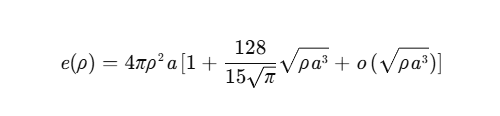
as the diluteness parameter $\rho a^3 \rightarrow 0$. Here $a$ is the scattering length of the interaction potential. This is the celebrated Lee-Huang-Yang formula for the energy density.
Understanding the energy to this precision requires a detailed understanding of correlations between the particles. Therefore, and because of the link between such energy questions and the property of Bose-Einstein Condensation of dilute gases of bosonic particles, proving such formulas for the energy density has been an area of intense activity in the mathematical physics community in recent years. This effort has also lead to a rigorous understanding of the Bogoliubov approximation for the interacting Bose gas.
In this talk, I will in particular review parts of the proof (joint with Jan Philip Solovej) of the Lee-Huang-Yang formula for the energy. I will also comment on the harder 2-dimensional case and how the proof can be modified to accommodate this case.
Bio-Sketch:
Søren Fournais is a professor at the Department of Mathematical Sciences at University of Copenhagen with research interests in the mathematical aspects of quantum mechanics. Søren received his PhD from Aarhus University in 1999. After positions at the Erwin Schrödinger Institute in Vienna and Université de Paris-Sud, he came back to Aarhus in 2006 first as Associated Professor and later Professor. He has joined the University of Copenhagen as a Professor since 2023.
Søren held a Starting Independent Researcher Grant from The European Research Council (2009-2014) on Mathematical Problems in Superconductivity and Bose-Einstein Condensation and a Sapere Aude DFF-Advanced grant (2015-2020). He became a member of the Royal Danish Academy of Sciences and Letters in 2014 and the Ministry of Science and Education awarded him an Elite Forsk-prize in 2018.